Dub vs Sub: Best Localization Strategy for Global Videos
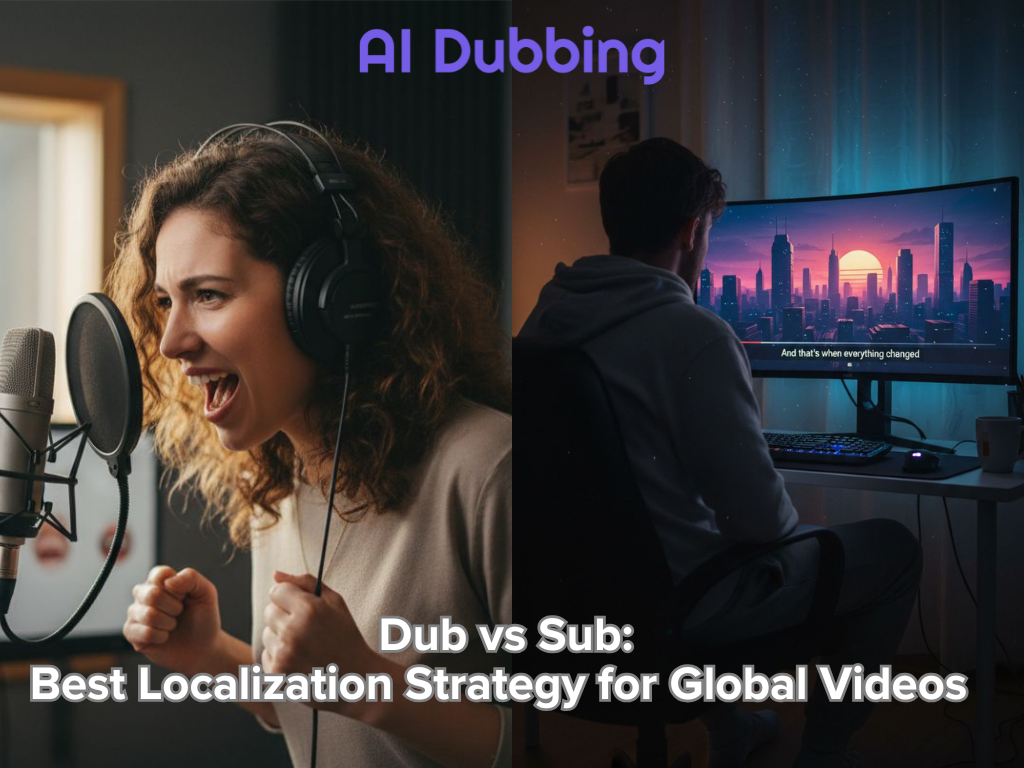
When your video crosses borders, language becomes more than a translation problem — it becomes a business decision.
The dub vs sub question sits at the center of global video localization.
This debate around dub vs sub has existed for decades in film and television. Today, it affects far more than entertainment. Content creators, global marketers, online educators, and international brands all face the same challenge: how to localize video content without losing engagement, trust, or performance.
Choose wrong, and your viewers may click away within seconds.
Choose the right approach to dub vs sub, and your content suddenly feels native, natural, and credible.
In this guide, we’ll break down the real difference between dubbing and subtitles, explore dub vs sub in real-world scenarios, and show you how modern AI tools like AI Dubbing let you combine both — forcing a compromise.
Dub vs Sub: What Do Dubbing and Subtitles Really Mean?
Before choosing between dub vs sub, it’s worth making sure we’re talking about the same thing. Many people use “dubbing” and “subtitles” casually, but the production impact — and viewer experience — are dramatically different.Understanding these differences is the foundation of making the right dub vs sub decision for global video.
1. What Is Dubbing?
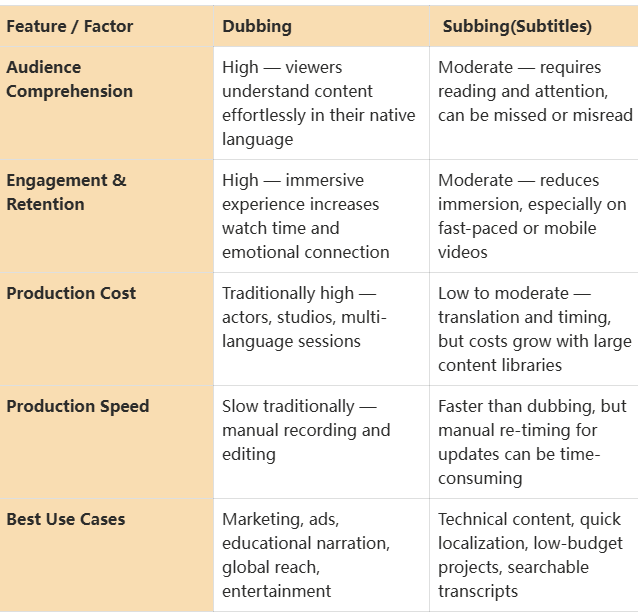
Dubbing replaces the original spoken audio in a video with a new voice track in another language. Instead of reading text, viewers hear the message delivered naturally in their native language.
In traditional workflows, professional voice actors match the original speaker’s tone, timing, and emotion. In modern localization, AI dubbing automates this process, dramatically reducing cost and turnaround time.
Pros——Dubbing works especially well when:
- The audience prefers listening over reading
- Emotional connection matters (ads, storytelling, brand videos)
- The video is long-form or educational
The biggest advantage of dubbing is immersion. Viewers do not need to divide attention between visuals and text. The content feels direct and effortless to consume.
Cons——But traditional dubbing also comes with drawbacks:
- High cost for voice actors and studios
- Long production timelines
- Difficult to scale across many languages
These limitations explain why many teams hesitate when facing the dub vs sub decision — even when dubbing clearly delivers a better viewing experience.

2. What Is Subbing?
Subbing, or subtitling, keeps the original audio while displaying translated text on the screen. It’s faster, cheaper, and far more common in online video platforms.
Pros——Subtitles are popular because:
- They are quick to produce
- They cost much less than dubbing
- They preserve the original voice and performance
For interviews, documentaries, technical tutorials, and news content, subtitles often feel natural and sufficient.
Cons—— In the dub vs sub debate, subtitles come with trade-offs
- Viewers must constantly split attention between reading and watching
- Small screens make subtitles harder to follow
- Many viewers simply ignore subtitles — or turn them off
In the dub vs sub debate, subtitles win on speed and cost, but often lose on engagement.

Dub vs Sub for Global Video: the Right Choice Depends on Real Scenarios
Choosing between dub vs sub is not a creative preference or a technical checkbox.
It is a decision that directly shapes how global audiences experience your content — and whether they stay, trust, and act.
In real-world localization projects, this choice impacts:
- Watch time and completion rates
- Audience retention and learning efficiency
- Brand credibility and emotional connection
- Conversion performance and ROI
Research consistently shows that people engage more deeply with content in their native language.
But how that language is delivered — audio or text — makes a critical difference.
Make the wrong dub vs sub decision, and even high-quality content can quietly fail.
A marketing video with subtitles may lose emotional punch.
An online course without dubbing may exhaust learners over time.
A short-form video with slow subtitles may lose viewers in seconds.
This is why dub vs sub is no longer a production detail.
It is a strategic localization decision.
1. Dub vs Sub for YouTube & Content Creators
For YouTube creators, TikTok producers, and short-form video makers, the dub vs sub decision directly affects one thing above all: retention.
On platforms driven by algorithms, the first 10 seconds decide everything.
Subtitles are fast and affordable, which is why many creators start with them. They work well when:
- The video is short
- The content is informational
- The audience already understands some English
But here’s the problem:Many viewers simply don’t read subtitles.On mobile screens, subtitles are small. On fast-paced videos, they are easy to miss. And once a viewer feels effort, they scroll.
Dubbing, on the other hand, removes friction completely.When viewers hear content in their native language, comprehension becomes effortless. Watch time increases. Engagement improves. The algorithm rewards the video.This is why many global creators are moving from subtitles to AI dubbing — or combining both.
In the dub vs sub debate for creators, the rule is simple:
- Subbing works for speed and testing
- Dubbing works for growth and retention
The best strategy?Start with subtitles, scale with dubbing.
2. Dub vs Sub for Marketing & Advertising Videos
For marketers, the dub vs sub question is not about preference — it’s about conversion.
Advertising is emotional. Tone, rhythm, and voice all influence trust.Subtitles can translate meaning, but they rarely translate persuasion.A viewer reading captions while watching an ad misses subtle pauses, emphasis, and emotion. The message becomes technical instead of emotional.
That’s why dubbing consistently performs better in:
- Brand storytelling
- Product demos
- Social media ads
- E-commerce videos
In multilingual campaigns, traditional dubbing used to be expensive and slow. Many teams chose subtitles simply because they had no alternative.
Today, AI changes that.With AI dubbing, brands can localize ads into multiple languages within hours, not weeks — and preserve voice tone across markets.
In the dub vs sub choice for marketing, the rule is clear:
- Subbing saves budget
- Dubbing drives revenue
And when conversion matters, revenue usually wins.
3. Dub vs Sub for Online Courses & Corporate Training
Education changes the dub vs sub equation again.
Here, the main goal is not entertainment or conversion — it’s comprehension.Subtitles are useful for:
- Technical reference
- Searchable transcripts
- Quiet environments
But long-form learning with subtitles has a major problem: fatigue.
Reading for 30 or 60 minutes while watching slides is exhausting. Many learners slow down, rewind, or simply stop.
Dubbing dramatically improves learning efficiency.When students hear explanations in their native language, they process information faster and remember more.
That’s why many global training teams now adopt a hybrid model:
- Dubbing for core lessons
- Subtitles for terminology and review
In dub vs sub for education, the winning formula is not one or the other — it’s both.

4. Scalability: The Real Hidden Cost in Dub vs Sub
When teams debate dub vs sub, scalability is often treated as a future concern.In reality, it is the core production challenge hiding behind every localization decision.
Most global teams don’t localize one video into one language.They localize dozens or hundreds of videos across multiple markets, on tight schedules, with constant updates.
This is where the true cost of dub vs sub quietly reveals itself.
Traditional dubbing is often seen as the premium option — and in terms of viewer experience, it is.But its production model is fundamentally linear. As content volume grows, so do coordination costs. In fast-moving markets, slow localization is often more expensive than imperfect localization.
Subtitles appear to scale better, and technically, they do.In the dub vs sub comparison, scalability achieved at the expense of viewer experience is rarely a sustainable win.
The uncomfortable truth behind dub vs sub:
- Dubbing delivers quality but does not scale easily
- Subtitles scale more easily but sacrifice experience
This is why so many localization projects quietly fail — not because of bad translation, but because the workflow itself cannot keep up with growth. And this is exactly the gap AI-driven solutions are now closing — which leads directly into the next section.
How AI Dubbing Combines Dub and Sub in One Workflow
After examining real-world dub vs sub challenges and dub vs sub trade-offs, one conclusion becomes unavoidable:
The problem is not which one to choose — it’s that traditional workflows force you to compromise.
AI Dubbing changes that by combining dubbing and subtitles in a single, AI-driven workflow.
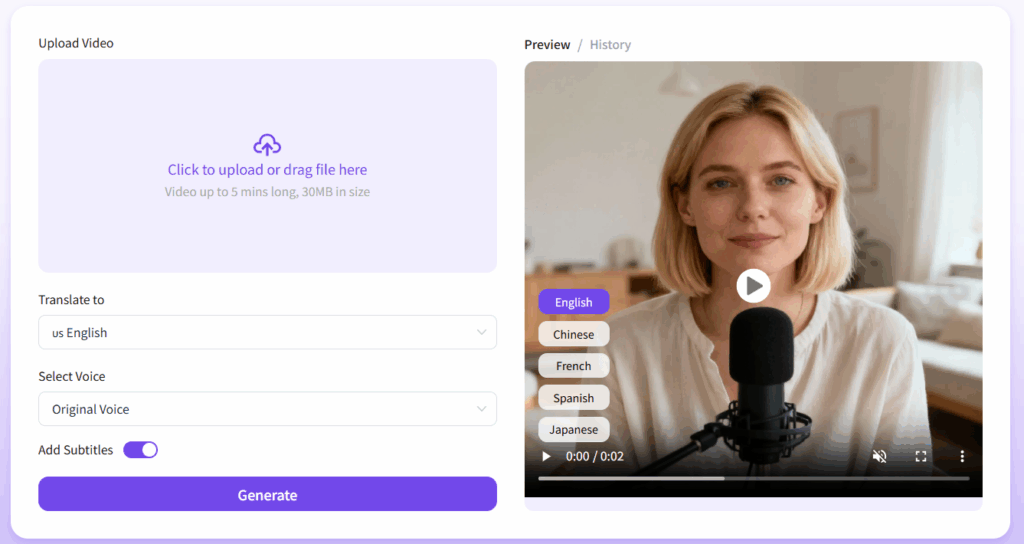
Step 1: Upload Video — One Upload, Multiple Languages
The first breakthrough AI Dubbing brings to the dub vs sub workflow is simplicity.
Traditional localization begins with fragmentation:
- One tool for translation
- Another vendor for dubbing
- Another platform for subtitles
- Manual synchronization across systems
With AI Dubbing, everything starts with one step: upload your video.
- The upload process is fast and intuitive.
- AI automatically recognizes the original language.
- From one upload, the platform prepares your content for both dub vs sub workflows simultaneously.
For content creators, marketers, and educators managing dozens of markets, this solves the key bottleneck in dub vs sub: scaling efficiently without compromising quality.
Step 2: Set Dubbing Parameters — AI Dubbing with Natural Voices
Quality is the second concern in any dub vs sub discussion.
AI Dubbing allows you to set dubbing parameters in seconds:
- Choose your target language for dubbing
- Select a preferred voice or clone the original video’s sound
- Decide whether to add subtitles automatically
Modern AI voices are now natural, expressive, and context-aware:
- Natural intonation and emotional variation
- Speaking rhythm and professional pacing
- Multiple voice styles for courses, ads, or creator content
AI ensures brand consistency across languages — something human dubbing struggles with.
No matter the language, your voice tone remains stable, solving a major challenge in dub vs sub: scaling without losing identity.
Step 3: Preview & Download — Auto-Generated Subtitles, Perfectly Synced
After processing is complete, AI Dubbing lets you preview and download your localized video.
- Character mouth shapes adapt perfectly to new languages
- Each dubbed video includes accurate multilingual subtitles
- Frame-level synchronization ensures subtitles match speech
- Reading speed is optimized for viewers
This creates a powerful hybrid model:
- Viewers can listen in their native language
- Turn on subtitles when needed
- Learn faster and retain more
- Boost accessibility, SEO indexing, and audience preference
In modern video localization, the real winner of dub vs sub is no longer choosing one or the other —
it is doing both efficiently with AI.
Final Thoughts: The Best Dub vs Sub Strategy Is Doing Both
After exploring costs, scenarios, and scalability, the answer to dub vs sub becomes clear.
Subtitles alone scale quickly but limit engagement.Dubbing alone delivers immersion but strains production.The most effective dub vs sub strategy today is not choosing one — but combining both.By integrating dub vs sub intelligently, global teams achieve:
- Native-level comprehension
- Higher engagement and retention
- Faster multilingual scaling
- Consistent brand voice across markets
With AI-driven platforms like AI Dubbing, this hybrid dub vs sub strategy is no longer complex or expensive.It is simply the smartest way to localize video for a global audience.